Shops in the neighborhood
in St. Gallen
The city of St. Gallen is launching a pilot project for neighborhood charging at three locations. In this post, we’ll explain what “neighborhood charging” means and offer tips on how to set up electric vehicle charging stations in your neighborhood.
Not everyone has the option of charging their car at home. Especially in cities, many people do not have their own parking space, the property owner refuses to install a charging station, or the costs and effort involved are not worth it. In such situations, public charging stations in residential neighborhoods offer a good alternative. Here, electric cars can be parked and charged at the same time.
What does “neighborhood store” mean?
“Neighborhood Charging” has become an established term in Switzerland for charging stations in public parking lots, primarily in residential areas. Typically, the local utility company installs AC charging stations in blue-zone parking lots. The primary target audience is local residents. However, since these charging stations are located on public property, visitors can also use the charging infrastructure.
With eCarUp , I've achieved our goal of setting our own prices, which was one of my main priorities in this project. We have control over our rates, and I'm confident that our example will set a precedent.
Connections in the blue zone allow for transfers
Car traffic will continue to be a part of urban mobility in the future, but it must become more climate-friendly. E-mobility is currently the energy strategy being relied upon to reduce the negative impacts of car traffic. The challenge lies in adapting the infrastructure accordingly.
In St. Gallen, the electrification of transportation is being tackled proactively.“From our perspective, it’s clear that a charging station must be in place first in order to motivate more people in the community to switch to an electric car,”says Vera Tettamanti, project manager for neighborhood charging at St. Gallen Public Utilities (sgsw). As in many cities, a significant portion of the population lives in buildings without private parking spaces. These residents mainly park in the Extended Blue Zone and do not have access to private charging stations. Charging stations in the Blue Zone therefore make it possible for many people to switch to electric cars in the first place.
Electric Vehicle Charging Stations in a Neighborhood in St. Gallen
Location Search
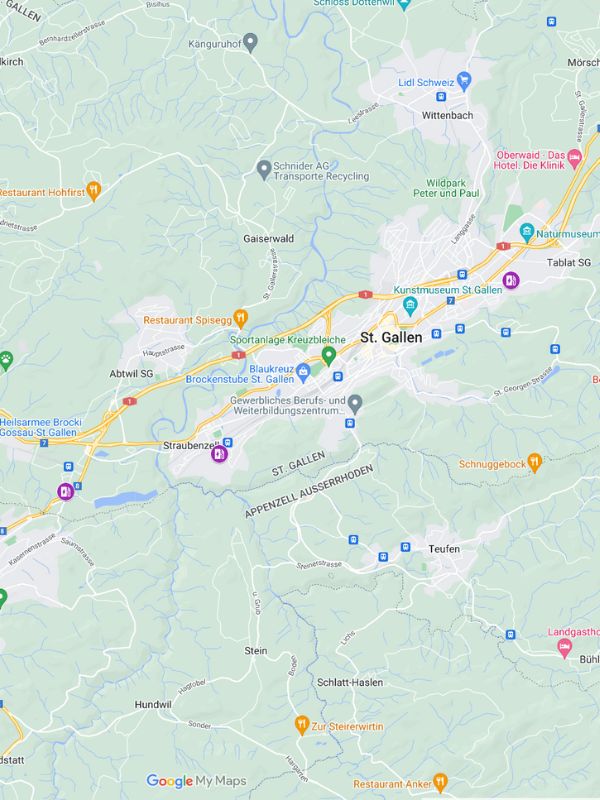
That is why the city of St. Gallen launched the pilot project “Electric Charging Stations in the Neighborhood.” Through an internal evaluation process, the city administration identified seven locations suitable for the pilot project. To determine the final three locations, residents within a defined radius of these seven locations were contacted directly. They were able to register their need for an electric charging station online. A total of 118 responses were received. After analyzing the responses, the three most frequently mentioned locations were selected.
Testing the Charging Stations
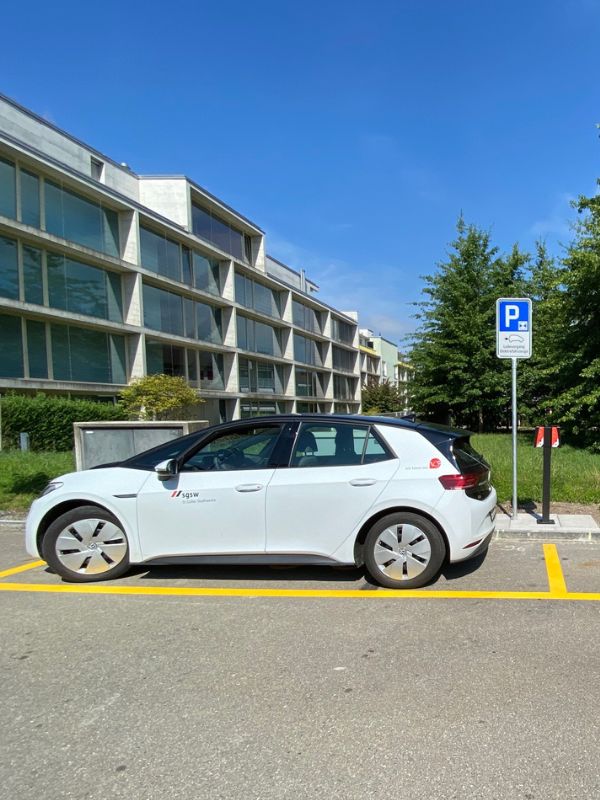
Sgsw began operating the three locations in July 2022. At each location, two charging points with a charging capacity of 11 kW each were installed. Charging stationsfrom Pico, easee, and Zaptec were used.“Since this is a pilot project, we’re taking the opportunity to test the various stations in public spaces,”said Vera Tettamanti.
Vehicles may only be parked in the specially marked parking spaces with charging stations while charging is in progress; they must not remain there afterward. Electricity must be flowing for a vehicle to be permitted to remain in the charging space. It is therefore not sufficient to simply plug in the car. A legal basis had to be established for this. Through a public notice—to which no appeals were filed—two parking spaces within the Blue Zone were re-marked as two charging spaces and signposted accordingly.“But certainly no one needs to move their car at 4:00 a.m. if it’s fully charged. If, on the other hand, the charging spots are blocked unnecessarily, we now have the authority to issue fines,”said Vera Tettamanti. Otherwise, the regulations for the Extended Blue Zone apply.
Billing
Occasional visitors can use the charging stations at a standard rate of currently CHF 0.45 per kWh. Residents, on the other hand, can sign up for a “Neighborhood E-Charging Stations” subscription to benefit from lower kWh rates, currently CHF 0.32 per kWh. The subscription costs CHF 10. per month. In addition, there would normally be a one-time activation fee of CHF 269.25, but during the pilot phase (through the end of 2022), the City of St. Gallen will cover this cost.
Users without a subscription are billed by credit card. Subscribers receive a monthly estimate every two months and a final bill once a year. Customers of St. Galler Stadtwerke can choose whether they want the service billed on their household electricity bill or on a separate bill.“This is an attempt to use pricing to keep the charging stations available for subscribers as much as possible. At the same time, however, we don’t want to exclude anyone from using the charging stations, so they are also available to guests. The subscription pays for itself starting at 1.5 full charges per month. With eCarUp , we’ve found exactly the solution we were looking for,”said Vera Tettamanti.
# Tip 1: Involving All Stakeholders
To cover as many perspectives as possible, all stakeholders should be involved. The project team for “Electric Charging Stations in the Neighborhood” in St. Gallen was structured from the outset so that all relevant city departments were represented on the team. These included the Department of Civil Engineering, the City Police, the Department of Building Construction, City Parks, Environment and Energy, and St. Gallen Public Utilities.“The project team was very well organized, and we received tremendous support from the entire City Council. That gave us so much momentum that working on the pilot project was a real pleasure,”said Vera Tettamanti.
# Tip 2: Use exchange platforms
It’s worth learning from the experiences of others. “We were able to benefit greatly from the experiences of Bern and Basel. There is a working group on e-mobility in public spaces, with representatives from the cities of Zurich, Bern, Basel, Geneva, St. Gallen, and the Swiss Federal Office of Energy. Thanks to this experience, we were able to address some challenges right from the start in a way that prevented any difficulties from arising in the first place.”
# Tip 3: Clarify Responsibilities
For now, the financing and, above all, the operation must be clarified.“The stations in the pilot project are owned by St. Gallen Public Utilities (sgsw), which also serves as the operator. The pilot project was financed by both sgsw and the City of St. Gallen’s “Environment and Energy” department.”How a larger-scale expansion could be financed is still under review. What is clear, however, is that sgsw will remain the operator. This means that sgsw is also responsible, for example, for maintaining the charging stations and ensuring that they remain in working order.
# Tip 4: Billing
Billing for the charging stations is also an important issue.“It was important to the project team that sgsw retain control over setting the price per kWh while also being able to offer two distinct service options—with and without a subscription.”Billing for electric vehicle charging stations requires new processes and can vary in complexity depending on the requirements.
# Tip 5: Establish a Legal Basis
Whether parking at charging stations is permitted only during the charging process or also beyond that must be clarified in advance and set forth in a legal basis. After all, what exactly does “charging process” mean? Does electricity have to be visibly flowing, or is it sufficient for the cable to be plugged in? In St. Gallen, this was clarified in advance so that no ambiguities could arise during operation.
# Tip 6: User-Friendliness
User-friendliness must always be the focus. When it comes to parking space availability, Vera Tettamanti sees room for improvement.“As a user, I want to be able to see online whether a parking space is available or not. The usefulness of checking on the relevant apps to see if power is flowing is limited. In that case, the parking space might be available—or it might be occupied by a combustion-engine or electric vehicle that isn’t charging. We’re currently in the process of installing ground sensors into the pavement. The occupancy status will be visible on our website.”Continuously improving the charging experience helps prevent frustration at the charging stations.
Charging stations in neighborhoods are a key component of the electrification of transportation
Environmentally friendly mobility will only become a reality if it is emission-free. The city of St. Gallen is laying the groundwork for this.“Charging in the neighborhood has great potential. The automotive industry has largely committed to phasing out internal combustion engine vehicles. If no new internal combustion engine vehicles are manufactured starting in 2035, then we need to take action now. We are convinced that the utilization rate of EV charging stations will rise sharply over the next two years, ” says Vera Tettamanti. Municipal energy providers such as sgsw are ideally suited to provide privately operated charging infrastructure in public spaces. This is particularly necessary in densely built-up urban neighborhoods where there is no possibility of installing charging stations on private property.
Interested?
We help energy providers implement neighborhood charging projects. Contact us for more information!
Contact
Any questions?
Our team is here to help you. Please contact us for a personalized consultation.
CH-6343 Rotkreuz
Send us a message
This form is protected by reCAPTCHA.